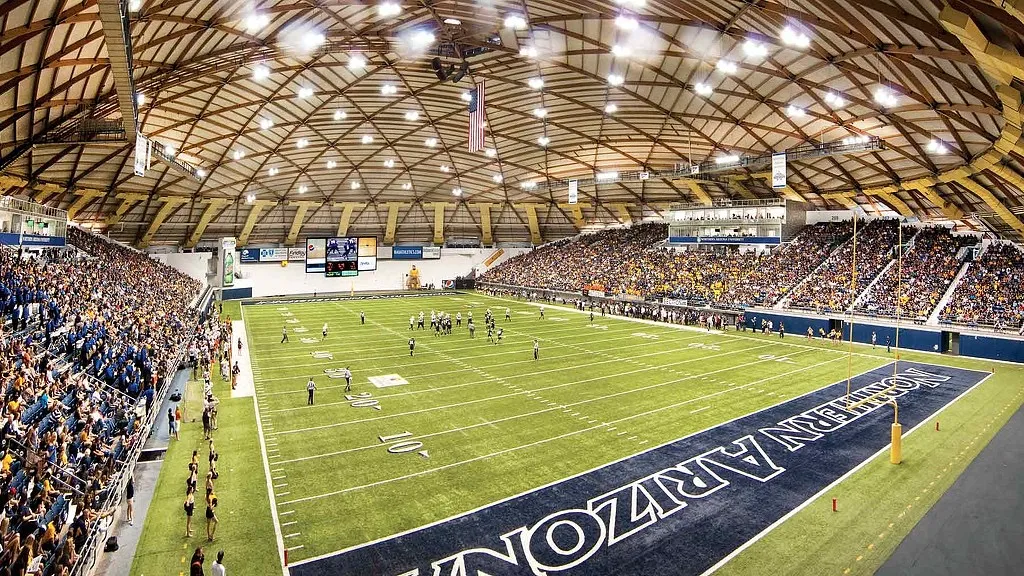
Skydome LED Lighting Upgrade
Replacing the Skydome's old high-bay fixtures with LEDs saves an estimated 1.27 million kWh and $156,792 a year, which pays back the $600,000 cost in 3.8 years.
- 1.27M kWhElectricity saved per year
- 406 tCO2e avoided per year
- $156,792Utility savings per year
- 3.8 yrsSimple payback
The project
The Skydome is NAU’s indoor stadium, and one of the largest single electrical loads on campus. Its lighting used high-intensity discharge (HID) fixtures that drew far more power than modern LEDs. The Green Fund approved an LED conversion in Fall 2019. COVID delays pushed the work back, and by the time it was ready in Spring 2022, material costs had gone up. An addendum that spring closed the gap.
The project cost $600,000 in total. The Green Fund put in $50,000 and the Sustainability Revolving Fund put in $250,000.
Impact
- Energy. The LEDs cut grid demand by 1,268,544 kWh a year.
- Carbon. That avoids 895,832 lbs of CO2e a year, about 406 metric tons, using the EPA’s eGRID factor for the regional grid (706.189 lbs CO2e/MWh).
- Money. The project saves $156,792 a year on utilities and pays back the $600,000 in 3.8 years. The savings go to the Sustainability Revolving Fund, so after payback the fund gets over $150,000 a year for new projects.
Beyond the utility bill
The bigger day-to-day change is maintenance. HID fixtures fail at the ballast, the capacitor and the socket, and every failure meant a work order. LEDs have none of those parts. Facilities no longer has to rent lifts, dispose of mercury-bearing lamps, stock spare ballasts, or clear the turf around classes and practices to change a bulb.
Methodology
Energy savings come from the consulting engineers’ pre-installation model and run-hour estimates. The Skydome has no metered data from before and after the retrofit.
Emissions are the modeled savings (1,268.544 MWh) times the eGRID subregion emission rate, which reflects the regional mix of gas, coal, solar, wind and hydro.
Payback is $600,000 divided by $156,792 a year, or 3.83 years. It uses the current contracted rate held flat. It leaves out maintenance savings like lift rentals and labor, so the real payback is likely shorter.