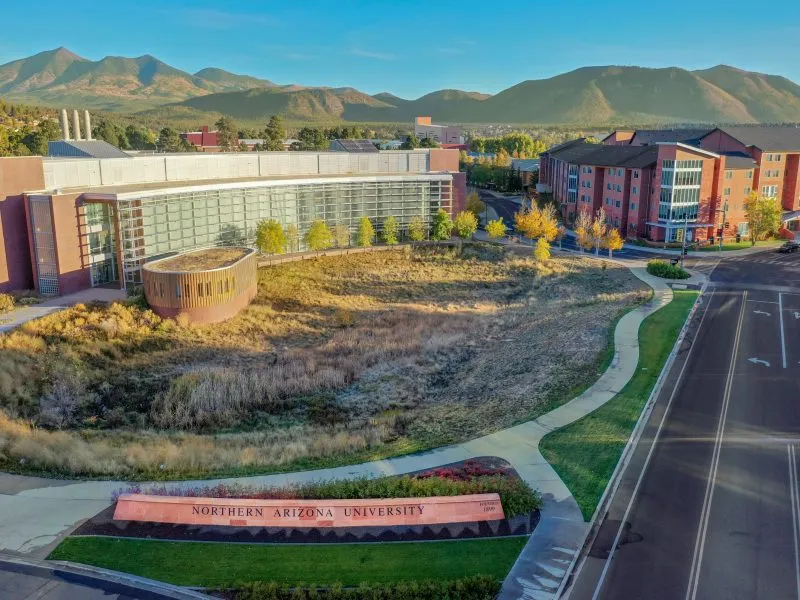
Calsense Irrigation and Turf Conversion
Smart irrigation controllers and native landscaping at seven campus sites save an estimated 2.6 million gallons of water and $11,232 a year.
- 2.63M galWater saved per year
- $11,232Utility savings per year
- 38%Less water on Calsense zones
- $158,048Project cost
The project
About 30% of NAU’s campus irrigation ran on smart controllers. The rest used fixed timers that barely adjusted for weather, and the university had no way to separate turf that needed watering from turf that didn’t. A lot of campus got overwatered.
The Green Fund approved this project in October 2024, alongside a WIFA Water Conservation Grant. It did two things:
- Calsense expansion. Four new Calsense smart controllers and flow meters now run the functional turf at four sites.
- Turf conversion. Grass that nobody used at Adel, Raymond and SBS West became native plantings, low-water lawn and gravel. Crusher fines paths and benches and tables made from recycled material turned those areas into places to sit.
Impact
Turf conversion
The conversion saves 582,225 gallons and $2,767 a year, about $0.09 per square foot converted.
| Site | Gallons saved per year | Dollars saved per year | Per sq. ft. |
|---|---|---|---|
| Adel | 292,211 | $1,388.96 | $0.083 |
| Raymond | 176,006 | $836.61 | $0.090 |
| SBS West | 114,008 | $541.91 | $0.096 |
Each landscape type saves a different amount compared with Kentucky bluegrass. Gravel and other inert materials save 25 gallons per square foot a year, native meadows and planting beds save 19, and low-mow lawn saves 9.5.
Calsense expansion
Smart control cut water use 38% across the four zones, saving 2,044,192 gallons and $8,464 a year.
| Site | Gallons saved per year |
|---|---|
| Gabaldon | 709,659 |
| Gammage | 628,218 |
| Riles | 442,710 |
| Central Quad | 263,605 |
Combined
Together, the two parts save about 2,626,417 gallons and $11,232 a year.
Beyond the numbers
Native plants give pollinators and birds habitat that a lawn doesn’t. Less mowing means less noise, fewer emissions and fewer labor hours. Since 70% of campus irrigation still runs on timers, the same approach could cover much more of campus.
Methodology
Turf baseline. Kentucky bluegrass in Flagstaff’s high-desert climate needs about 25 gallons per square foot a year.
Replacement landscapes. Plant and Seed in Flagstaff puts native conversions at 60 to 80% water savings. I used 76%, which leaves 6 gallons per square foot. Fine-fescue low-mow lawn needs about 15.5 gallons. Gravel and other inert materials need none.
Cost. Flagstaff’s water rates change by month with usage tiers. I used NAU’s 2025 monthly water logs to spread the savings across the year, then priced each month at its rate.
Calsense baseline. No one metered these sites before the controllers went in. I took post-install usage and scaled it back to a baseline with an efficiency factor of 0.62, the average from studies in climates like Flagstaff’s.